
MAPV
Mobility Assistance for Visually impaired People through Collaborative Acoustic Positioning (MAPV) project
According to the World Health Organization (WHO), at least 2.2 billion people experience near or distant vision impairment. This vulnerable population faces significant mobility problems in the urban environment, limiting their independence and confidence. While the white cane is a common mobility aid, recent visually impaired people (VIP) avoid using it due to shame or being afraid of unwanted attention. Many prefer to navigate independently rather than rely on others for assistance.
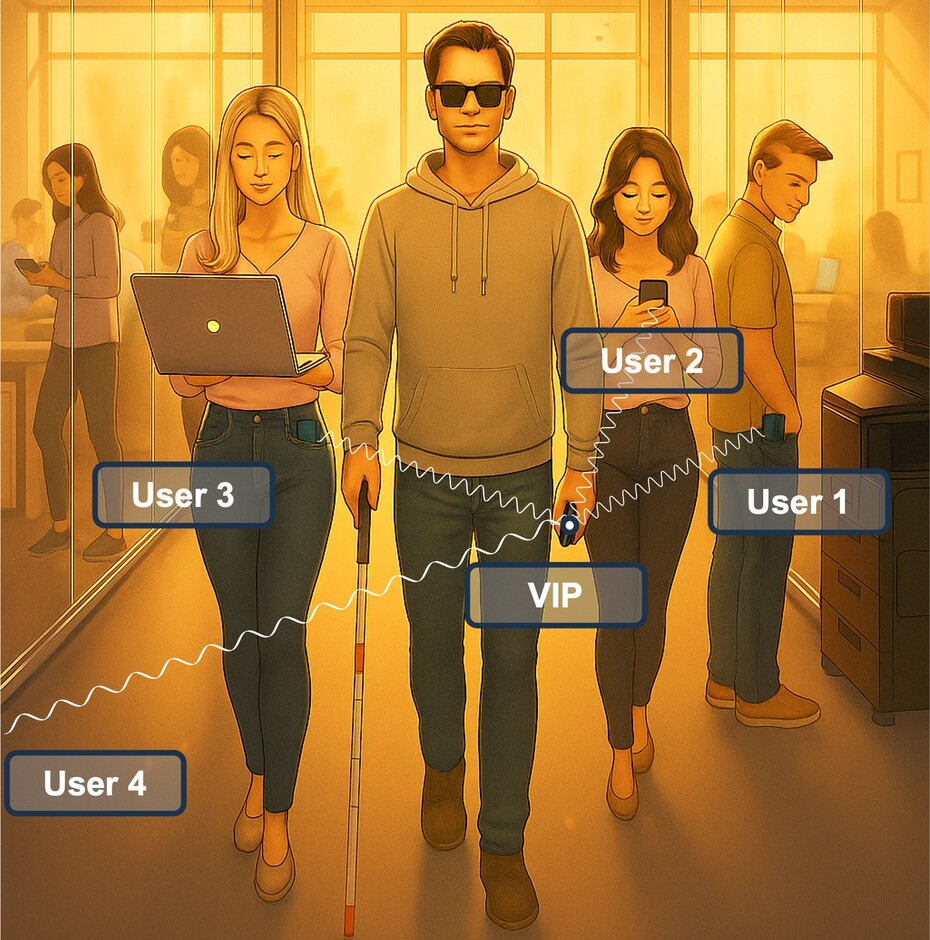
The ubiquity of wearable/mobile devices enables the design of Collaborative Positioning Systems (CPS), which use nearby devices to seamlessly share positioning and distance data. This enhances positioning accuracy while eliminating the need for direct users’ interventions, with each device acting as a dynamic anchor and data broadcaster in the background. VIP primarily use sound and touch for spatial awareness, using auditory clues for orientation, obstacle detection, and danger awareness. Real-time positional awareness is vital for VIP to improve travel planning, reduce anxiety, and enhance overall quality of life. Thus, enhancing spatial awareness through AI-driven ambient sound classification—mirroring how VIP naturally sense their surroundings— is key to promoting independence and confidence.
The primary aim of MAPV is to enhance the quality of life of visually impaired people (VIP) by enabling independent, accurate, and safe mobility in complex environments, while preserving user privacy. To achieve this, MAPV explores a collaborative, AI-driven, sound-based positioning approach that:
- Does not rely on intrusive infrastructure
- Avoids vision-based sensing
- Integrates acoustic data from multiple mobile devices and nearby users
- Enhances spatial orientation and landmark identification through AI-based environmental sound recognition
Special attention is given to minimizing sound invasiveness for visually impaired users and guide dogs, while ensuring high positioning accuracy, strong privacy protection, and reliable collaboration between mobile devices.
Found: MAPV (2026–2030) is funded under the ANR JCJC program (ANR-25-CE22-1631-01)
Contact:Pavel Pascacio